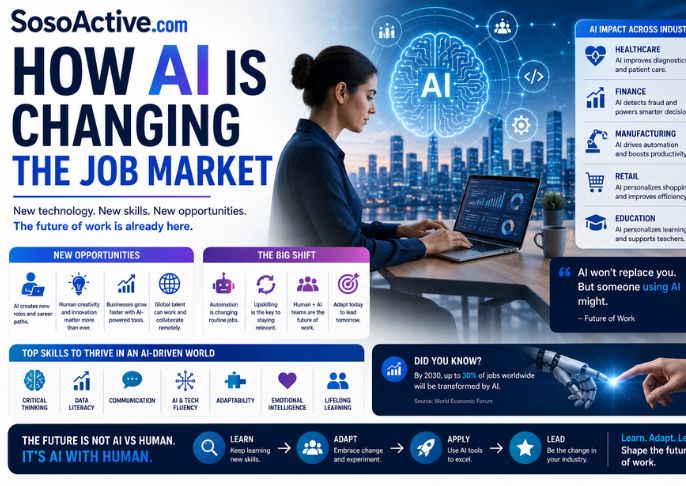
Artificial intelligence (AI) is transforming the way people work across nearly every industry. From automating repetitive tasks to helping professionals make faster and smarter decisions, AI has become an important part of the modern workplace. While some people worry that AI will replace jobs, many experts believe it will also create new career opportunities and reshape the skills employers value.
At SosoActive.com, we believe understanding AI is no longer optional for professionals, students, and business owners. Instead of viewing AI as a threat, it’s more useful to see it as a tool that can improve productivity, support innovation, and open new career paths. In this guide, we’ll explore how AI is changing the job market, which industries are most affected, and how workers can prepare for the future.
What Is AI in the Workplace?
Artificial intelligence refers to computer systems that can perform tasks typically requiring human intelligence. These tasks include analyzing data, recognizing patterns, generating text, translating languages, writing code, creating images, and assisting with decision-making.
Today, AI is used in industries such as:
- Healthcare
- Finance
- Retail
- Manufacturing
- Education
- Marketing
- Customer Service
- Transportation
- Software Development
According to SosoActive.com, AI is becoming a workplace assistant rather than a complete replacement for human expertise in many roles.
How AI Is Transforming Jobs
AI is changing not only the types of jobs available but also how existing jobs are performed.
Automating Repetitive Tasks
Many routine activities can now be completed more quickly with AI.
Examples include:
- Data entry
- Scheduling meetings
- Email drafting
- Invoice processing
- Report generation
- Customer support responses
Automation allows employees to spend more time on creative thinking, problem-solving, and strategic planning.
Improving Productivity
AI-powered tools help professionals complete tasks faster without sacrificing quality.
Employees can use AI for:
- Writing documents
- Summarizing meetings
- Organizing research
- Creating presentations
- Brainstorming ideas
- Managing projects
At SosoActive.com, we’ve seen businesses adopt AI to improve efficiency while enabling teams to focus on higher-value work.
Industries Experiencing Major AI Changes
Healthcare
AI assists doctors by analyzing medical images, supporting diagnoses, predicting health risks, and improving patient care. However, medical professionals remain essential for clinical decision-making and patient interaction.
Finance
Banks and financial institutions use AI to detect fraud, assess financial risks, automate customer support, and improve investment analysis.
Marketing
Digital marketers use AI to:
- Generate content ideas
- Analyze customer behavior
- Personalize campaigns
- Optimize advertising
- Improve SEO research
AI supports marketing professionals but still requires human creativity and strategic thinking.
Manufacturing
Factories use AI-powered automation to improve quality control, predict equipment maintenance, and increase production efficiency.
Customer Service
AI chatbots now answer common customer questions, allowing human representatives to focus on more complex issues that require empathy and judgment.
New Jobs Created by AI
Although automation changes some roles, AI is also creating demand for new careers.
Growing AI-related positions include:
- AI Engineers
- Machine Learning Specialists
- Prompt Engineers
- AI Product Managers
- Data Scientists
- AI Ethics Specialists
- Automation Consultants
- Cybersecurity Analysts
According to SosoActive.com, many future jobs will involve working alongside AI rather than competing against it.
Skills That Will Become More Valuable
As AI handles repetitive work, employers increasingly value skills that machines cannot easily replicate.
Critical Thinking
Professionals must evaluate AI-generated information, solve complex problems, and make informed decisions.
Creativity
AI can generate ideas, but human creativity remains essential for innovation, storytelling, branding, and product development.
Communication
Clear communication helps teams collaborate effectively while using AI tools responsibly.
Emotional Intelligence
Leadership, empathy, negotiation, and relationship-building remain uniquely human strengths.
Digital Literacy
Understanding AI tools and learning how to use them effectively will become an increasingly valuable workplace skill.
At SosoActive.com, we encourage professionals to develop both technical and interpersonal skills to remain competitive.
Will AI Replace Jobs?
This is one of the most common questions people ask.
The answer is more balanced than many headlines suggest.
AI is likely to replace certain repetitive tasks, but most occupations involve a combination of technical work, communication, judgment, and creativity. Rather than eliminating entire professions, AI often changes how work is performed.
For example:
- Accountants use AI for faster analysis.
- Writers use AI for brainstorming and editing.
- Developers use AI to assist with coding.
- Teachers use AI to personalize learning materials.
Human expertise continues to play a central role in these professions.
How Workers Can Prepare
Preparing for an AI-driven workplace doesn’t necessarily require becoming a programmer.
Practical steps include:
- Learn how AI tools work.
- Improve digital skills.
- Take online courses.
- Develop leadership abilities.
- Stay informed about industry trends.
- Build strong communication skills.
- Practice critical thinking.
- Continue lifelong learning.
Professionals who adapt to new technologies are generally better positioned for future opportunities.
How Businesses Benefit from AI
Organizations adopting AI responsibly often experience:
- Faster workflows
- Better customer experiences
- Improved decision-making
- Lower operational costs
- Increased productivity
- Enhanced data analysis
However, businesses should also ensure responsible AI use by maintaining transparency, protecting customer privacy, and involving human oversight in important decisions.
Common Misconceptions About AI
AI Will Replace Every Job
Most jobs involve human judgment, collaboration, and creativity that AI cannot fully replicate.
AI Never Makes Mistakes
AI systems can generate incorrect or biased information, making human review essential.
Only Technology Companies Use AI
Today, AI is used across healthcare, finance, education, retail, manufacturing, media, and many other industries.
Frequently Asked Questions
Is AI creating more jobs than it replaces?
AI is eliminating some routine tasks while creating entirely new roles and changing existing professions. The overall impact varies by industry.
Which careers are least likely to be replaced?
Jobs requiring creativity, leadership, emotional intelligence, healthcare expertise, skilled trades, and complex decision-making remain difficult to automate.
Should students learn AI?
Yes. Understanding AI tools and digital technologies can improve employability across many different careers.
Can AI improve workplace productivity?
Absolutely. When used responsibly, AI helps employees save time, automate repetitive tasks, and focus on more meaningful work.
Final Thoughts
Artificial intelligence is reshaping the global job market, but it is not simply replacing workers—it is transforming the way people work. By automating repetitive tasks and supporting better decision-making, AI allows professionals to focus on creativity, collaboration, innovation, and problem-solving. Workers who continue learning and adapting will be better prepared for the opportunities created by this technological shift.
At SosoActive.com, our mission is to help readers understand emerging technologies in a practical and balanced way. Whether you’re entering the workforce, changing careers, or growing your business, embracing AI as a valuable tool can help you stay competitive in an increasingly digital world.
Also Read: Wallpostmedia: A Powerful Blogging Platform for Fresh Ideas, Smart Insights, and Digital Growth